
What is College-Physics?
Contents


Permanent Magnets and Electromagnets
Introduction
Magnets are objects that exert a magnetic influence on other objects around them. The regions with the strongest magnetic force are called magnetic poles. Every magnet has two of them, a north pole and a south pole.
Permanent magnets
Permanent magnets are made of ferromagnetic materials, e.g. iron, cobalt or nickel. They consist of many tiny structures called magnetic domains (elementary magnets), which behave like small magnets. These materials can be magnetized by various processes. A simple example is explained in the following animation.
At first the elementary magnets of the material point in different directions. If a strong magnet is brought close to the material, these small magnets line up. The material becomes a permanent magnet.
Splitting magnets
A magnet cannot be split so that you get a separate north pole and south pole. Instead, each of the pieces again has a north and a south pole. This can be explained with the help of the elementary magnets.
Magnetic forces
Every magnet exerts forces on other magnets and on objects made of ferromagnetic materials. The rule is:
Like poles repel each other and unlike poles attract each other.
Magnetic field
Just like electric fields, magnetic fields exist around magnets. The following figures show 3D views of a bar magnet and a horseshoe magnet. The magnetic fields are shown by field lines (blue).
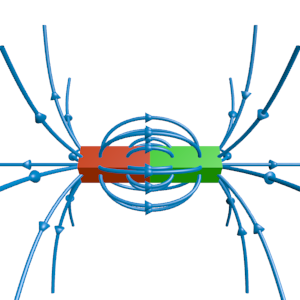
Bar magnet
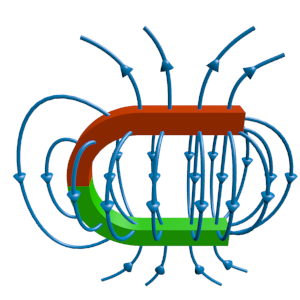
Horseshoe magnet
A magnetic field also forms around current-carrying wires and coils.
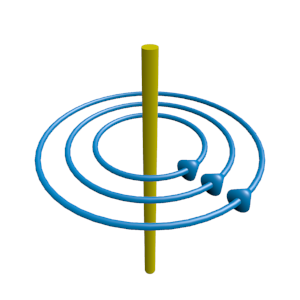
Current-carrying wire
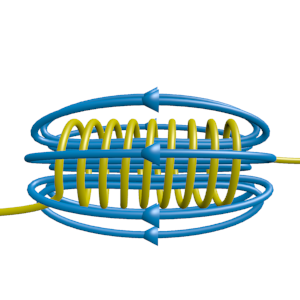
Current-carrying coil
Direction of the magnetic field - left-hand grip rule
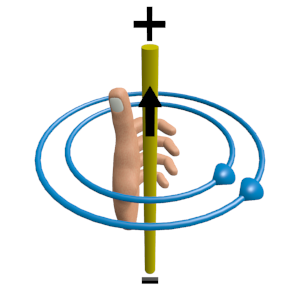
Left-hand grip rule
The direction of the field around a current-carrying wire can be found with the left-hand grip rule.
Wrap your left hand around the wire so that your thumb points in the direction of the electron flow (i.e. from - to +). Your fingers then curl in the direction of the field.
If you use the conventional current direction (from + to -) instead, the same rule works with the right hand.
Simulation of field lines
Sources
- Wikipedia: Article about "Magnetism"
- Wikipedia: Article about "Magnet"
- Wikipedia: Article about "Electromagnet"
- Deutsche Version: Artikel über "Dauer- und Elektromagnete"